
ONCE UPON A TIME – AN INTERVIEW WITH GEENA WILKINSON
November 2025
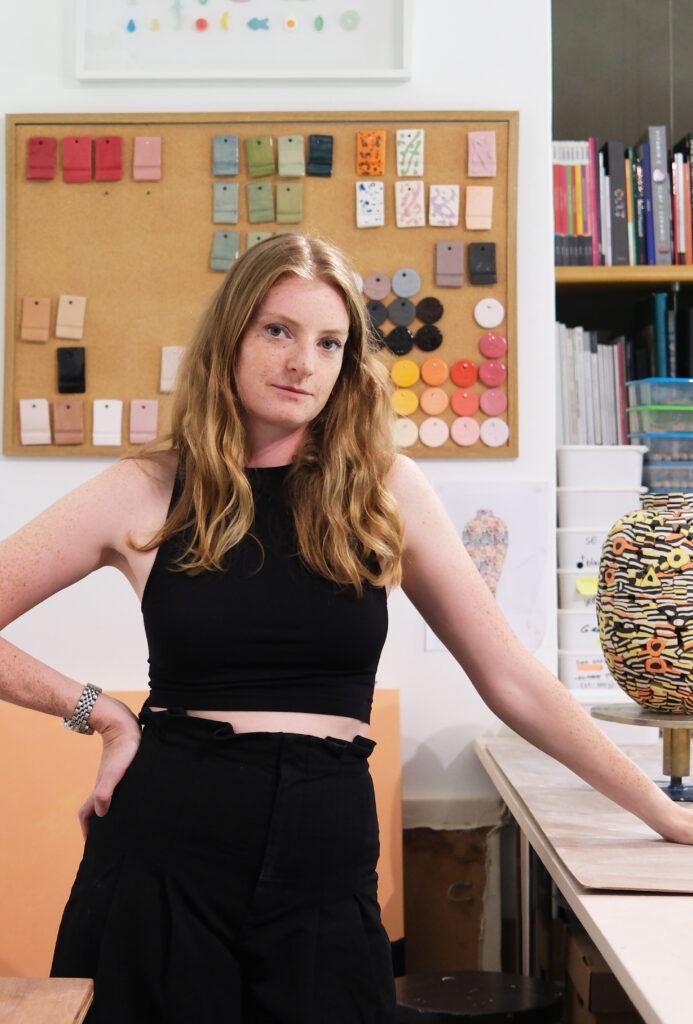
Your ceramics are playful and often evoke nostalgia—how do you decide which everyday objects or memories to capture in clay?
Sometimes the process of making starts with an object, and sometimes it starts with a story. With this piece, as with many myths and fables, it is unclear which is which. For me, making an artwork is a way of working through things going on in my mind. It is the repetitive nature of sculpture and ceramics – the recipes that I use over and again – which allow for this openness of thought. I always seem to return to the tasks in studio that give me ample space for daydreaming.
Many of your pieces are whimsical yet slightly impossible, like sweets you can’t eat. What draws you to this playful, slightly surreal approach?
Stone Fruit, as an artwork and an installation, is posed as a statement, but it is also meant to be received as a question. The obfuscation in the title is more than an arrow pointing towards the medium. Stone Fruit takes the form of an orange tree composed from its parts: bark, leaves, and fruit. It a composition of ceramic stoneware sculptures. But an orange has never been a stone fruit, neither has a naartjie, or a tsatsuma. Can a story be pieced together with only a couple of its parts? Can a tree grow without its roots?
Once Upon a Time is a storytelling-themed exhibition—how does your work fit into or respond to the idea of a “story”?
Stone Fruit began as an exploration of the beginnings of Oranjezicht, a central Cape Town city suburb, seemingly named after a fruit. The more that came to light, the more the inquiry grew. Its story shows how quickly we take for granted how things came to be.
One of the first things we’re taught at school are the primary and secondary colours. This we take for a fact, but it is rarely acknowledged that chrome orange is a colour with late origins. Both the colour we know as ‘orange’ now and the fruit of the same name had been around for a long time before they converged into their own colour category. While other similar chromatic pigments in this range have ancient roots, chrome orange was first synthesized in 1809, and has only been sold commercially to artists since the early 1900s. Before this, orange, as we know it, was only a fruit, and the colour we know today had not yet been individualised and named. It was simply called yellow-red.
Before Oranjezicht was a suburb, it was a farm, spanning all the way from the slopes of Table Mountain down to where the Mount Nelson Hotel stands today. The farm had ample water from Platteklip, a stream which runs through it year-round and fills the Molteno Reservoir, which at present, supplies areas in the inner city, and in the past gave life to the farm’s orange groves, with the reservoir serving as the city’s first hydro-electric power plant (it powered the first electric street lights in Cape Town). It is noted by Patricia Davison in her book co-published with Adrienne Folb, entitled Oranjezicht: Recalling the past; cultivating the future, that the farm was not named after this fruit. In the early 1700s, when the farm was first named, it was Dutch owned, and in the Dutch language, sinaasappel was the word in use at the time to describe an orange. In English, this translates to Chinese apple, denoting its origins from the east, which today have trickled down to the use of the word mandarin amongst others. The story of the suburb and the story of the fruit diverge, and the further back you go, the wider the story branches, the branches turn to tendrils, the tendrils turn to leaves, and leaves eventually fall off the tree.
Can you share a bit about your process—from initial idea to finished ceramic piece? Are there moments when the work surprises you?
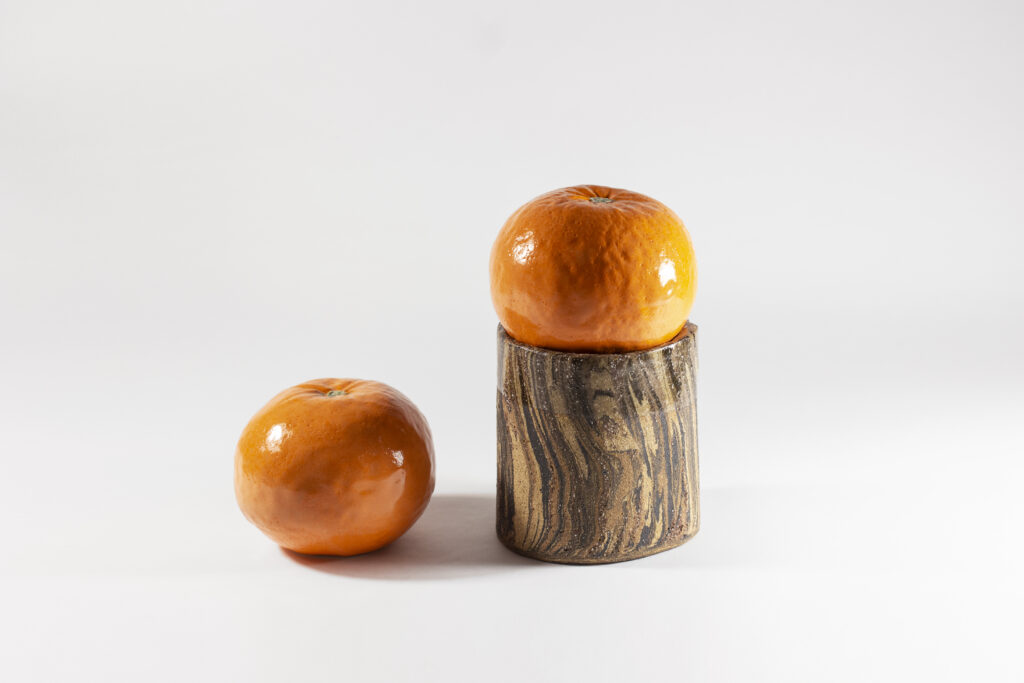
This piece, like many of my framed works, is a composition of different shapes and colours – here they take the form of ceramic stoneware sculptures. The stoneware oranges are slip-cast. Despite this being a duplication technique, each casting comes out differently because it is done by eye and not by weight: a heavier layer inside pulls the navel of the orange in when the mold is flipped. The curve of each leaf is taken from draping clay over ocean-rolled rocks.
The tree trunk of the installation is composed of earthenware vessels made from four different types of clay brought together using the Japanese ceramic process of Nerikomi. The clays are sliced and layered like brushstrokes in a painting, and then rolled into a slab for building. Making these was a dare to the kiln itself because all those four clays shrink at different rates, so I wasn’t sure if the vessels would warp and crack in each firing. I thought I would never know unless I did it anyway and my new favourite pastime has been learning as much as a can about the physics of clay particles – there’s a beauty in their unpredictability, but I do also feel that since I’ve taken note of the mechanics behind this material, it’s becoming easier to play roulette. Sometimes the sheer volume of irregularities manages to balance it out.
Looking ahead, are there memories, objects, or stories you’re excited to explore in future projects?
When I was photographing this piece, I enjoyed playing around with all the different stories that emerged when the parts were re-arranged. It really brings out how much the curation of objects affects the narrative. I liked how the oranges transformed when they were stacked, so I’m keen to play around with multiplying and arranging things and find out the stories that will come with that.
It’s always when a work is done, and the pressure is off, that you end up in a state of being able to play in a wonderfully loose way. I think it’s the space where the magic happens, and usually where the next work is born. I always think of something I heard a long-distance runner say in a talk once, which was that the most difficult race is always the next one. But as a runner, although not particularly long-distance one, and as an artist, there is a similar thing that happens after you finish a run or an artwork, where your brain is suddenly quiet and relaxed, and then sometimes it starts freewheeling into all of the possibilities of what will be next, like passing a level in a game that unlocks a secret door you couldn’t see before.
Various art classes given by independent tutors. These include Drawing, Painting and Etching.
These classes are designed to encourage interaction between students, tutors, artists and others to create a vibrant ambiance.
Thursday evenings.
Tuesday mornings, afternoons, and evenings; Friday mornings.
Monday mornings.