
AN INTERVIEW WITH MATTHEW BLACKBURN – PORTRAIT AWARD TOP 40 FINALIST
November 2025

Your practice moves powerfully between environmental still lifes and portraiture. What connects these two worlds for you, and what makes a subject: whether a person or an object, worth painting?
My work captures the human experience; people will have interactions with their surroundings. It’s us as humans who disrupt the environment, often in the pursuit of convenience and wealth.
A lot of my ideas evolve from one another. Back in 2020 I was painting Coca-Cola bottles/cans, trying to capture the nostalgic feeling that the brand had created, now, in 2025 I’m still using Coca-Cola in my works but in a more critical manner that symbolises greed, consumerism and pollution.
Not everything I paint is a masterpiece, but it’s worth painting if it teaches me something and contributes to the bigger picture.
As a Top 40 Portrait Award 2025 finalist, your portrait stands apart from your well-known environmental pieces. What drew you into portraiture, and what story were you aiming to capture in the portrait that was selected?
I have always enjoyed portraits; a few well-placed brush strokes can instantly create life on a flat surface.
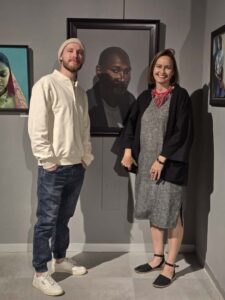
The sitter in my painting “Humble” is South African artist Bambo Sibiya. I first met Bambo in 2024 at the Latitudes art fair. I had some work on display, and I got chatting to him about one of my paintings, which was of another South African artist, Kamogelo Masemola. It turned out that Kamogelo was actually one of his mentors while he was coming up in his artistic journey. It was a great compliment to know that I was able to capture the likeness of his mentor.
Eventually he ended up showing me some of his artworks and I was mesmerized; his works were definitely one of the highlights of the fair. A week or so later I attended his solo exhibition with Everard Read, getting to hear about his process and subject matter. Needless to say, I was inspired and the seed of wanting to paint him had been planted.
Fast forward to the Latitudes art fair 2025, I ended up running into him again. Within 30 seconds of our conversation, I told him that I wanted to paint him for the upcoming Portrait awards. It would allow me to pay my admiration to him and allow his legacy to be captured within my artwork. He gracefully accepted and two weeks later the portrait “Humble” was born.
Your environmental works often explore human impact on nature through hyper-realism, symbolism, and discarded materials. How does your message or intention shift when you are painting a person rather than an object or landscape?
Objects are very subjective; they can have many different meanings. So, when I paint someone, I’m trying to capture “Them”, not just the way they look but also their presence and emotion. For us as humans we are able to identify most facial expressions, so if I’m able to recreate those emotions in my portraits, it is easier for the viewers to relate to and ultimately understand the mood being created.
Your technical approach is incredibly layered and meticulous. What challenges or discoveries did you encounter when applying your process to portraiture, such as skin, emotion, vulnerability compared to plastics, surfaces, or organic materials?
Using acrylic paints is never an easy process, creating the right viscosity is very important. It can be a frustrating medium that takes a lot of trial and error.
Every new material that I create comes with its own challenges, but that is part of what I love, having to figure out new steps or techniques to recreate them on a flat surface. Once I figure out a new material it just becomes part of my arsenal of knowledge for future artworks.
Humans are not identical, there are different ethnicities, genders, ages, emotions… The list goes on and on, which is exciting! It just means there is so much more to discover as an artist, every time I paint a new person I’m learning.
Looking forward, do you see your portraiture and environmental themes blending more, or will they continue as parallel conversations in your work? What direction excites you most for the next chapter of your practice?
My themes will all overlap in their relevance to one another. Sometimes they may appear separate, but in the long run and full narrative of my artistic practice, they all come together.
I just want to create interesting paintings that bring me joy and can impact people who view them.
Various art classes given by independent tutors. These include Drawing, Painting and Etching.
These classes are designed to encourage interaction between students, tutors, artists and others to create a vibrant ambiance.
Thursday evenings.
Tuesday mornings, afternoons, and evenings; Friday mornings.
Monday mornings.